Most consultants hand you a deck. We hand you the working system.
We have run operations for 25 years. The tools we needed never got built — now we build them, usually in days, and you do not have to explain what a provisioning queue is, or what the regulator will ask for.
Telecom is where we learned it. We work with network and fibre contractors, operators and ISPs, energy and utility crews — anyone planning field work in a shared spreadsheet, or finding out what a subcontractor cost only after the month has closed.
What we do
Take it apart. Rebuild it. No handoff.
Operations Diagnostic
Find where the operation leaks time and money — and leave with one fix already running.
A ranked list — and one fix already running
02 · 2–4 weeksBuild Sprint
The tool your operation needs, in production in weeks, at a price agreed before we start.
A working system in production, and the repository
03 · MonthlyRun
Your software, kept running and improving by the people who built it — for one flat monthly fee.
Changes live in days, for one flat monthly fee
Three rungs, not three unrelated products. The diagnostic ends with a working prototype, which is what makes the sprint a decision rather than a leap of faith.
Before and after
From one of our case studies: a contractor with 100+ technicians, planning the day from a spreadsheet.
BeforeEvery morning, 1,100 jobs copied into a spreadsheet by hand
AfterEvery job and every technician on one screen, every 30 minutes
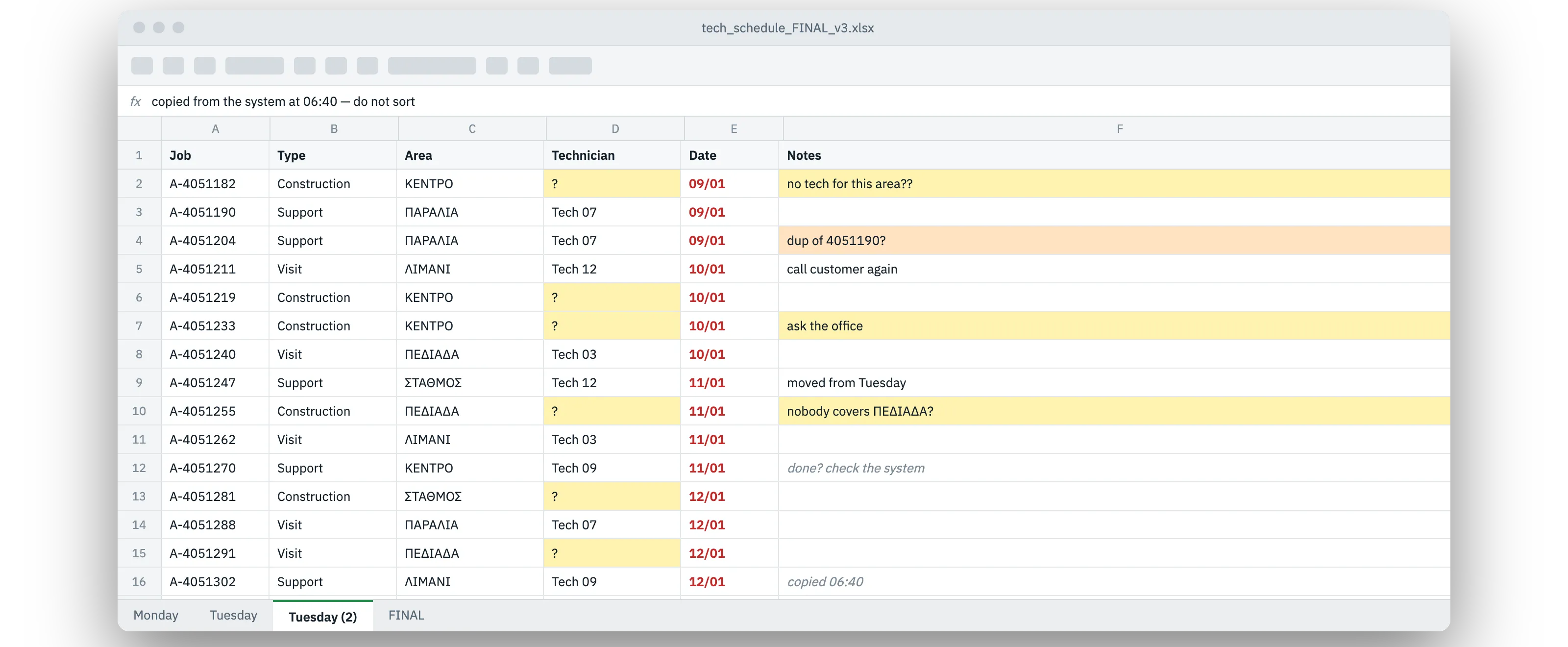
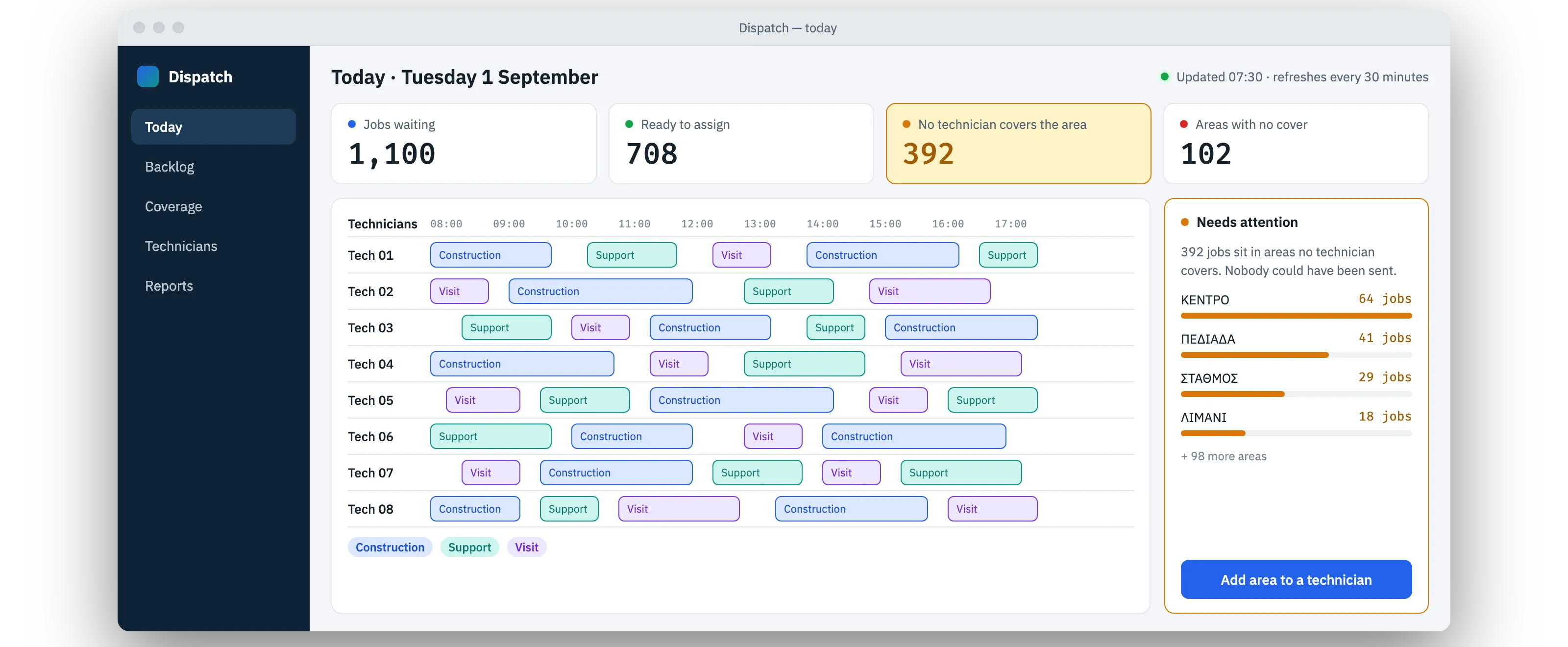
Before
- 1Copied out of the system by hand, every morning
- 2Which of these jobs can anyone actually be sent to?
- 3Dates stored back to front — 1 September became 9 January
After
- 1A third of the waiting jobs could never have gone to any technician — found in week one
- 2The fix is one step: give the area to a technician
Illustrative interface. All values synthetic.
The gap
Consultancies understand the operation but cannot build.
Integrators and OSS vendors can build, but will not take a €15,000 job.
Freelancers will take it, but do not know what a provisioning queue is — or what the regulator expects.
Nobody who understands the operation is also willing and able to build the small tool it needs. That is the whole business.
Common questions
Who is "we"?
A small senior partnership rather than an agency. Between us we cover telecom and infrastructure operations, software delivery, and the regulatory and commercial side of the Greek and EU market. You deal with the people doing the work — there is no account layer between you and them.
Can you handle the regulatory and compliance side, not just the software?
Yes, and it is usually the part that decides whether something is workable. Reporting obligations, licensing and permitting, and what a regulator will actually accept as evidence shape the data model long before anyone writes code. We would rather raise those constraints in week one than discover them at go-live.
Is what you build a prototype, or is it production software?
Production. A build sprint ends with a system deployed at a URL, running on real data, with the repository handed to you. The diagnostic includes a genuine working prototype rather than a mockup, but it is scoped as a proof — the sprint is what hardens it.
Who owns the code?
You do, entirely. You get the repository with its full commit history, the documentation, and a handover session covering how to run and change it without us. There is no licence, no hosting lock-in, and no black box.
Who maintains the system after you hand it over?
That is exactly why the handover is part of the deliverable rather than an optional extra. You hold the code, the documentation and the walkthrough recording, so any competent developer can pick it up. If you would rather we kept it running and improving, that is what Run is for — a flat monthly fee, and the code stays yours.
You use AI to build. Does that mean the work is generated?
No. AI compresses implementation — scaffolding, boilerplate, integration glue, iteration speed. It does not decide which problem is worth solving, sit in the room with your team, or own the outcome. Those are the job. The speed is why this is affordable; the judgement is what you're buying.
Do you work in Greek?
Yes. Delivery, documentation and meetings in Greek or English, whichever suits your team. Written deliverables are usually in English unless you ask otherwise, because that is what most technical documentation ends up being maintained in.
How do you price?
Fixed price for a defined scope, never an hourly rate. You agree the number before work starts and carry no overrun risk. Ranges are published on each service page along with what moves them, so you can estimate before we speak.
We're small. Are we too small for this?
Probably not — small companies are the ones with no analyst and no spare engineering capacity, which is the whole reason this exists. If a diagnostic is more than the problem is worth, we will tell you on the call and suggest something cheaper, including doing nothing.
Book a call
We reply within one business day.
Book a callIf what you need is a platform replacement, we are not it — we will say so on the call and point you somewhere.